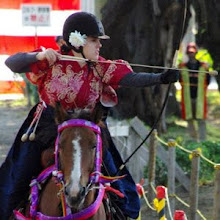
We were at Kushihiki Hachiman Shrine in Hachinohe. It is both the most famous and the oldest shrine in Hachinohe. The Meiji Emperor is supposed to have stayed there when traveling in Aomori. More about the shrine later.
Anyway when we finished caring for the horses it was time to go in the shrine for the ceremony. Most people, when going on hatsumode or most other times, pray at the alter outside. They throw a few coins in the offering box and then ring the large bells hanging from the rafters. They bow, clap twice, pray, clap again, and finally bow again. There are different degrees in formality in how many times you bow and clap. I haven’t figured it out completely yet. However, we weren’t bound for the plebian outside but rather for the inner part of the temple. We were dressed in our formal jackets and breeches, though we obviously had to take off our riding boots to enter the shrine. The owner of the riding club and five of the riders (including me) entering the waiting room to the side of the shrine. It was a tatami room, heated by and electric brazier in the center. The owner of the riding club (who we all call sensei) went to one of the attendants to giving the offering of money and sake while the rest of us waited. Honestly, it wasn’t a very interesting room, traditional, with little ornamentation, a few picture on the walls. We waited in the crowded room for the priest to be ready. Eventually he came in to the room. He was wearing a long overcoat of blue brocade, with hakama pants and the hard brown hat that has a bump in the back. He was carrying a long wooden fan, and invited us into the back of the shrine. We walked into the main space of the shrine, which was behind the offering box and bells. There were rows of low seats, where you could sit with your legs tucked under you.
The room was very interesting, it was actually a combination of four different rooms with large sliding doors to separate the rooms, but the only doors closed were the ones behind us leading out to the front of the shrine and the offering box and bells. We could hear the rattle of coins and the ringing of the bells as people came to the shrine to pray. Directly in front of us was an empty table and beyond that another room. The room was dominated by the offering tables with mochi (rice beat into a past used for celebration) and sake. Beyond that was another set of sliding doors that led outside to the heart of the shrine. Faintly I could see the symbol of the deity, a large silverish mirror set into rock. To our right was a small room that contained a huge drum, and to our left was a small room that we had come through to enter the inner shrine, with a table.
We sat at the low chairs with our lower legs tucked under us. It was cold in the inner shrine, the back door to the shrine being left open so that we could see the mirror that represented the deity. (This part is a little fuzzy because it’s taken me so long to write this post.) The ceremony started as an assistant priest (second in charge?) banged the big drum to our right and the head priest asked us to bow and he began to pray. I don’t know exactly what he said, even a lot of Japanese have told me that they can’t completely understand what the priest says. He almost sings the chants in an odd kind of tonal singing that sounds similar to the singing of the narrators in Bunraku and other traditional Japanese theater. I was told that he was praying for the good health, fortune etc. of those people gathered there. Anyway, we spend the better part of a half and hour bent in half bowing. Finally when the priest was done praying and blessing the offerings we could sit up. The next part of the ceremony was when representatives from each group would get up to make an offering (?) or prayer (?) for the group. The priest in charge instructed them what to do. The assistant priest gave them an evergreen branch tied with the ceremonial rice paper (shaped like a bolt of lightning in Western terms) and the representatives took it placed in on the offering table and bowed twice, clapped twice, prayed, then bowed twice again. (There might have been a second round of clapping in there I can’t exactly remember.) Then the sat down again. After everyone had finished the ritual, the priest ended the ceremony and we all went to take a sip of the blessed sake (that stuff was amazingly strong!!!) and left the shrine.
After we get outside we returned to the horses and we waited for the priest who came outside to bless the horses. We got them all lined up and bowed again. The priest waved his ___ (it’s a long thin wand with many strands of the ceremonial rice paper tied to the end) over the horses and prayed for the good health of the horses in the coming year. Then we took pictures (which I will post as soon as I have a copy) and finally it was time for lunch. (Yum!)
Coming back was like going, same route etc. I rode Michael so I wasn’t worried about the Yakiimo man but Western (who was ahead of us) freaked out again. So it was through the crowds, over the bridge, down the stairs, across the rice paddies, and back up the mountain for us. It was a long day but it was tons of fun!! This trip was a trip of many firsts and it was the best experience I’ve had in Japan so far this time! I hope that I can do it again next year!!
Tuesday, February 03, 2009


Tuesday, January 06, 2009

初詣 ~ January 2, 2009 Part 1
On January 2nd I went on hatsumode. Hatsumode is the first shrine visit of the year in Japan. On the 1st through 3rd of January Japanese people go on hatsumode to their local shrine to pray for the new year. I, of course, was also going to go on hatsumode, but not the normal way, I was going to go by horse!
Since coming to Japan this time I joined the local riding club called Polo. The people there are great! I don’t have a car so they pick me up at the train station, and drop me back off again when I am done. The are always willing to talk to me, and often let me hang out all day. It’s a fun club, were people learn to ride and enjoy going on trail rides together. The horses at the club aren’t my beloved, elegant Arabians, the are the traditional horses of Japan, a breed called Dosanko, and are not the most beautiful of horses. They’re short, I would estimate them to average about 13-14 hands. The smallest is closer to twelve and the largest is probably about 14+ hands. They have big heads and big round bodies, with a short thick neck connecting the two. Never destined for the dressage ring, they make perfect trail horses, surefooted and hardy, and for the most part calm. Originally breed to be warhorses, they now are a dying breed, (as are all Japanese horse breeds) unable to compete with Thoroughbreds, Warmbloods, and Arabians in racing, dressage, and jumping which are the popular horse sports in Japan today. These horses are still used in one of their traditional sports. The reason that the club is called Polo is because they still play traditional Japanese style polo at the local shrine each year. I didn’t get to see it last year so I’m definitely going this year!
So, back to hatsumode. I woke up pretty early that morning to meet one of the nice ladies from the riding club that lives near me so we could carpool to the barn. It was cold but clear, which was great because the weather earlier that week was calling for snow and rain. We got lucky. We got to the barn, tacked up, got dressed, figure out who was going to ride when (we had more riders than horses) and off we went. The riding club is on the top of a mini mountain on the edge of Hachinohe. It’s a rather steep mountain in fact, so the first challenge of the trail ride was to navigate ourselves down the mountain. Doing this always reminds me of a passage in the Tale of the Heike when one of the generals successfully sneaks up on his enemies by bringing his mounted army down a cliff face that the enemy was using to guard their backs from attack. Anyway, the horses are very surefooted so even though it was icy and snowy it wasn’t that bad. We successfully navigated the mountain and crossed the road to stop for a brief time at the convenience store to go bathroom, change riders etc.
The next phase of the ride took us through the dormant ride paddies. For all that the mountains are steep in Japan, the flatlands are well…flat, no hills or anything. Cultivated that way over centuries for rice growing. Rice paddies are like large rectangular pans with the sides built up into walkways and roads. Even though most of the ground here is frozen now, the ground in the rice paddies is still soft. However, the roads and walkways were perfect for trail riding as we trotted and cantered though them. Surrounding the paddies were the train tracks for the local lines and the shinkansen (bullet train) which flew by as we passed. It was a lot of fun and quite invigorating. We changed horses and walked through the rest of the rice paddies and into the outskirts of town where we paused to put on our formal riding jackets and make sure that everyone had a leader for their horse.
I probably should take a moment to name the horses. We had 6 of them with us, and by the end of the ride I had ridden all but one. They were Chibi, Buchi, Kotaro, Icchi, Michael, and Western. Chibi and Kotaro are both black geldings, Chibi is a bit larger, and I think a bit calmer as well. I ride Chibi a lot. Kotaro can get a little grumpy. Buchi is the old lesson horse that everyone loves, me included, and is still fit and healthy even though he is approaching 30 years old. He is also the tallest horse and a brown and white pinto. Icchi is the smallest horse, and a palomino. I’ve never rode him so I don’t know his personality very well. Michael is a red chestnut horse, quite good at jumping, but tricky. He gave me my first fall in years after going over a two foot jump and stopping the minute his front feet hit the ground. He’s a good trail horse though. Western is another brown and white pinto and a bit more high strung than the others, though I’ve only ridden him once.
We had stopped by the river, below a huge bridge that crossed the river and headed towards the shrine. While I generally spend most of my days in a bit of a daze of confusion, I became slightly more confused when I couldn’t figure out how we were going to get up to the bridge, the only way I could see was the stairs but we weren’t taking the horses up those, right? I mean they were nice stairs each step being quite wide, in fact short people (like me) would have probably taken a step forward between each step down. But they were still stairs.
Well, I was wrong. We did in fact take the horses up the stairs. I was riding Western and was a bit nervous. Climbing stairs on horseback is actually like climbing a steep hill. The horses seemed fine with it, so it was all good. Another new experience for Alyssa. But directly after the stairs was the bridge. It wasn’t a particularly large bridge width-wise. Enough room for a side walk on each side and one lane going in each direction. However it was a rather tall bridge, and we were riding on the raised sidewalk and the whole time the only thing that I could think of was that while the horse might be protected by the side rail, on the horse I was not, the side rail did not go up that high, and it was a very steep drop. Needless to say I survived. What was amusing was that the cars passing by would inevitably slow down and little faces would be pressed to the windows in surprise.
After the bridge was the main road leading to the shrine, and it was packed. I mean Michigan Stadium on a Saturday after a game lets out packed. It’s a good thing that the horses were pretty calm because the roads were mobbed. We were able to slip down a small side road to head to the shrine. Then we headed down the road towards the torii. Western was fine until we reached the yakiimo man. Yakiimo is baked sweet potato that is sold by vendors at festivals, and on the street during the winter. Historically they would sing as they walked, announcing their wares. Now they play a recording. As we came by the cart the yakiimo guy closed the lid of the cart and about gave Western a heart attack. But since I managed not to run over any pedestrians, it was all good.
We finally, after about two hours, arrived at the shrine. We tied the horses up and took off their bridles and loosened their saddles.
This is just part 1. Will try to finish part 2 by tomorrow. Pictures too!
Thursday, January 01, 2009
Update
Hello :)
Since Mom sent out this blog address and my new site is nowhere near finished I thought that I would update this site for now.
So where is Alyssa?
I'm back in Japan again. This time teaching English to elementary and middle school kids. I work as an assistant language teacher, traveling to many schools to teach English. It's a lot of fun and I really enjoy my job.

 Hachinohe City
I'm currently on winter vacation, and will post pictures when I have time!
Since Mom sent out this blog address and my new site is nowhere near finished I thought that I would update this site for now.
So where is Alyssa?
I'm back in Japan again. This time teaching English to elementary and middle school kids. I work as an assistant language teacher, traveling to many schools to teach English. It's a lot of fun and I really enjoy my job.

Aomori Prefecture
 Hachinohe City
I'm currently on winter vacation, and will post pictures when I have time!
Saturday, April 01, 2006
Flying is a pain in the butt!
Well I'm here in Detroit, overnighting before flying to Manchester NH tomorrow. If tomorrow is anything like today was I will commit mass murder...
My Day...
Wake up 4:30 am get dressed, haul bags downstairs, check out. Get on flight to Tokyo...sleep Zzzz...
Get to Tokyo, wait an hour before I can check luggage...do nothing, watch the people milling around like lost cows...
Finally check in...only to find out that my luggage is 1.5 kg and 3 kg over. If its less than 2 kg over you pay 3000 yen extra...if it is more you pay 22,000 per kg... ... ... not impressed... so I take out some heavy stuff and go through the security AGAIN...pay the airline an extra 6000 yen...vampires...
Send package via air...I NEED my dvds
Eat breakfast finally...just make it too McDs before they close the B-fast menu...
Shop, realize I have no money...stop shopping
Go through immigration, find out that I was ONE day late leaving the country...get sent to immigration, you know where the send the illegal immigrants...spend ~1 hour apologizing, explaining, being really nervous...pay 4000 yen for extension of 15 days...I'm surrounded by vampires....
Get on plane...have asile seat *thank you Dad* but sit next to smelly Chinese guy who keeps poking me with his elbows...the plane was full of Chinese, a lot of them with crying babies, very little english skills...leave a little late because they wouldn't listen to the Flight attendants...
Fly to Michigan...try to sleep but fail...keep failing...keep failing...finally fall asleep... ... ... get woken up for B-fast...
Get off plane, go through immigration...forget to speak English...immigration guy looks at me kinda funny
Get bags...half rip off one of the handles of the black bag...
Go to hotel...sleep for four hours...
Wake up...hungry...order pasta...forget, yet again, that I'm not currently in Japan and have to pay the nice delivery boy tips...when he knocks on the door respond "Hai!"... ... ...give really measly tip...
That has been my day today...so much fun <-- *sarcasm*
Thursday, June 16, 2005
Rainy Day Blues
And so the Rainy Season starts in Japan with the year's first Typhoon and Rain, Lots of Rain. Rain when I wake up, rain when I go to school, rain at lunch, when I study, when I sleep. The never-ending rain. Days of rain. Weeks of rain. Okay damnit enough bloody Rain!!!!!!!!!!!!!!!!!!!!!!!!!
Tuesday, June 14, 2005
Goodbye Arnie
On Monday, June 13 at 3:10 pm Hilda Gerrish passed away. She was a wonderful woman and like a Grandmother to me and will be greatly missed. Goodbye Arnie, I love you.
Thursday, May 26, 2005


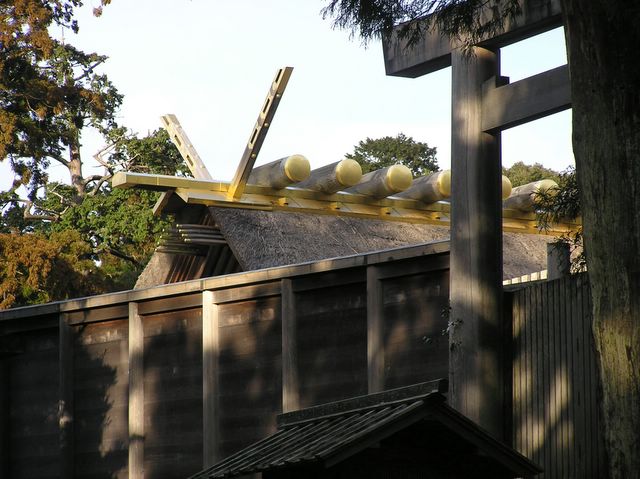
The Inner shrine is actually a complex of 4 or 5 buildings. The first shrine is veiwable by the public, the second shrine is veiwable by those who pay a very large fee, usually large companies, to be blessed. The shrines beyond that are off limits to anyone but the High Priests and the Emporer. The reson for this is that in one of those shrines is the Bronze Mirror one of Japan's Three Sacred Treasures. This is the second shrine from right outside the complex.


Well Hello Everybody!!!
I know, I know, it's been forever since the blog's been updated, I'm sorry! Busy Busy Busy, but I will be updating it now with things from Febuary onward!!
First up is the trip I took to Ise on Feburary 27, 2005. Ise is the religous center of Shintoism with the shrines there dedicated to the Sun Goddess Amaterasu Omikami and Toyouke no Omikami, the goddess of the harvest, as well as others.
Tuesday, May 24, 2005
Odaijini: An Exciting Adventure to the Japanese Doctor's Office
For the past few days I have been fighting off a spring cold, complete with sniffles, sneezes, and, as usual, my ears filling with fluid. While valiantly fighting the cold and the annual ear infection that always accompanies such colds, with the myriad of drugs I, semi-legally, carted into Japan, the decongestant ran out. Knowing that, while my mother would be more than willing to send me more decongestant, my ear was at the point where it would become infected by tomorrow if I didn't do something about it today.
So, prodded forward by the many painful memories of past ear infections, I asked my Sensei where I should go to by decongestant. Well actually, since the words "ear infection" and "decongestant" and "ears filling up with fluid" are not listed in my dictionary, a shocking oversight in my opinion, I first had to make him understand what was wrong. Using known words like mizu-water, mimi-ear, and itai-ouch, along with new words like teieki-body fluids, and jibiyou-infection, I managed to make him understand. His response, like the responses of most Japanese people, was immediate, you should go to the doctor. Now, as a westerner living in Japan, I have heard vague horror stories about Japanese doctors, and everyone knows a friend of a friend who had a cousin who went to the doctor in Japan and was never seen again. Besides I knew that I just had to take the decongestant for a few more days, get lots of rest, and then would feel better. But this is Japan, and apparently self-medicating is not something the Japanese do. So after some polite arguments on my part, and equally polite counter-arguments by my Sensei and the people at the students office, I was given the address of a Ear, Nose, and Throat Doctor, and sent on my way.
So I took myself home, muttering to myself all the way. But, I was caught, if I didn't do something today I was going to end up with an ear infection, and I really hate ear infections. So I took a deep breath and called my friend Steph who lives in my apartment building, to ask her to be my moral support and reader of the all important Kanji. To my great Joy and Happiness she agreed and is promoted to Angel Status.
Off we went to the doctor's office, which looks remarkably like American doctors offices with a waiting room filled with couches, sick people, over energetic children, and a soap opera showing on TV. The questionnaire even asked the same questions, although they were in Japanese, and I was extremely thankful that Steph came along to help with the Kanjis. The first sign that I wasn't in Kansas anymore was the nurses who wore pink nurse dresses that looked like they came from the 1950s with cute little nurse hats, you know the ones that don't stay on a person's head unless they use hair pins. So I answered the questions, filled out the forms and waited.
After a while the nurse called my name, and I got up thinking, okay now to see the doctor, but no, they lead me to a secondary waiting room where people almost ready to see the doctor wait. Steph amused herself with playing her gameboy, while I amused myself by trying to listen in on the conversations of people around me. In the first waiting room an older man, who had gotten there before us was sitting there, and another man, who obviously was a friend came in. He walked up to the man sitting next to us and joked "So are you going to die?" and the man sitting next to us said "Well you never know." In the second waiting room, two older ladies sat there discussing which parts of their bodies the were there for the doctor to see. It was kinda interesting in a "look I can understand what they are saying" kind of way.
When not eavesdropping on the conversations of people around me I was examining the parts of the doctor's office that I could see. The strangest thing was this device that blew medicated air, through a tube, up a persons nose, or down their throat. It was a very popular device as a large number of people seemed to come in just to use the device.
After the normal long wait, we finally got to see the doctor, and I got my first shock. Unlike in America the doctor's exam does not happen behind closed doors, but rather right in the open where, if the people using the nose device were to look diagonally behind them they could see everything going on. Then their was The Doctor, who as opposed to the nurses looked like he came out of the 1850s with his white coat and round silver eye thing that you see doctors wearing on their heads in historical movies. Not a comforting sight by any means. In attendance on The Doctor stood three, yes three, nurses, whose only job seemed to be to assist The Doctor with his examinations. So I sat down in a chair, that unlike the normal exam chairs, looked more like one of those chairs that they electrocute criminals in. The Doctor was sitting at his desk near by, and without looking up from his desk asked me "what's wrong?" I was not really paying attention and was waiting for him to look up. After a short, uncomfortable silence he looked up, shot a sharp glance towards me, then towards the nurse standing next to me, then down to his papers. The nurse immediately turned to me and repeated the question "what's wrong?" Shocked, and slightly intimidated, I responded in my broken Japanese "mimi ni mizu ga tamatteitte sucoshi itai desu" or "my ear is filled with fluid and hurts a little." The Doctor then grunted, yes actually grunted, and motioned to nurse #1 who got my chair turned 90 degrees, while nurses #2 and #3 scurried around preparing things.
When the preparations were done The Doctor looked up and slid is chair over to the exam chair. He then moved his scary metal eye thing in front of his eye, stuffed a cold metal tube in my ear, and looked in my ear, motioned to the nurse to turn my chair 180 degrees, looking in my other ear, motioned to the nurse to turn me back around and then look in the first ear again. He then said something fast and technical which I didn't get at all and then, when my confusion was obvious he said something slightly less technical and I got that my ear was red. I nodded, yes the ear was probably red because of the imminent ear infection. He then proceeded to look in my ear and use a Japanese ear cleaning utensil, which looks like a q-tip except with out the cotton on the end. It hurt, and I flinched. Nurse #1 then politely said "it will hurt but please bear it." The Doctor then took, what I later learned from my friend looked like a large needle, and as far as I can tell, poked a hole in my ear to release the fluid. It really hurt, but I managed not flinch so as not to be scolded by the nurse again.
While I was still recovering to the sudden pain in my ear The Doctor quickly moved to my nose, shoving a metal funnel like thing up it and looked at it through his scary eye thing. He then came at me with a scary pipe cleaner look alike utensil as I began to back away. He shot an exasperated look at nurse #1 who yet again said "it will hurt but please bear it" and stuck the thing up my nose to take a sample. He then sprayed fluid up my nose and down my throat, and slid back to his desk. "Does your ear feel better?" He asked.
I again sat there in silence looking at The Doctor. This time I wasn't confused, I was trying to find something polite to say to The Doctor. This is Japan after all... The response in my head was "of course it doesn't feel better you dumbass, you stuck a needle up it! It hurts!!! What do you think your doing sticking needles in me without asking!? And damnit look at me when you talk to me!!!!!!!!" However, my response was "not really." In Japanese that was rude enough to get The Doctor to look at me with a slightly shocked and very exasperated look. The Japanese never outrightly contradict doctors, but as observed I am not Japanese, and his scary look was less intimidating then the weird metal eye thing he was wearing. So after some more technical Japanese that I didn't understand at all, he sent me with nurse #3 over to the first machine in the office that I recognized, which was weirdly comforting. So after some happily non-painful tests, I was sent back to the waiting room for a short time before being summoned before The Doctor once more.
The Doctor informed me that he thought the fluid filled ear feeling was cause by a little bit of wax and implied that the problem was very small and time-wasting. He then proceeded to ask me if I wanted to have some medicine to get rid of my (very small) runny nose. I, now ceasing to be shocked by his manner, told him I thought it wasn't that serious and I wasn't really bothered by it. He then replied, in language that you would use with a very small child, that wouldn't it be better to fix the problem. I, hanging on to my foreigner in Japan politeness by very thin greasy threads, made small non-committal noises and stood up to end the examination, paid the small fee not covered by my insurance, and left.
It's a few hours later now and my ear still hurts, but the fluid has drained some. But in truth even if I do get an ear infection I'm not sure that you could drag me back to the doctor for anything. As my neighbor said, seeing a Japanese doctor makes you think it would be worth the cost of a flight home to go to your own doctor that see a Japanese doctor.
Subscribe to:
Posts (Atom)